
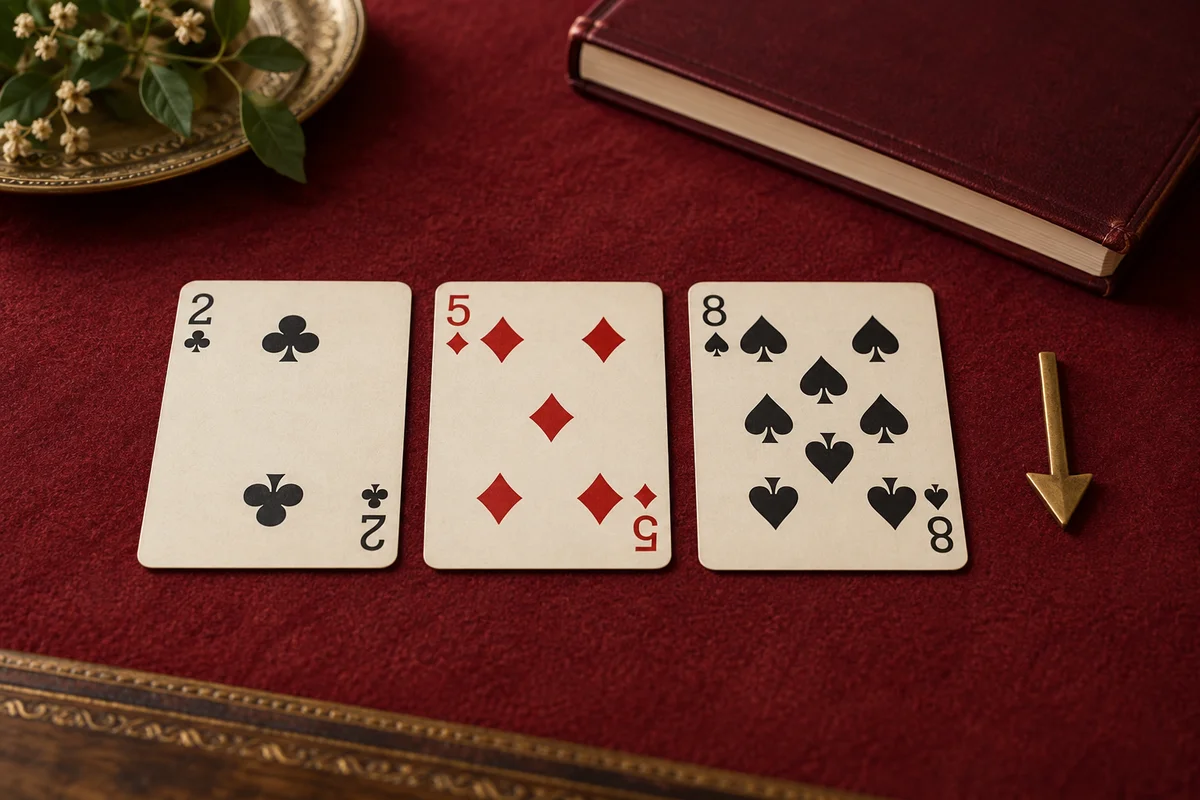
Illustration for this guide; not an app screenshot.
You look down at three low, unrelated cards and instinctively want to pack. In Muflis, that reaction can be based on the wrong ranking system. This Teen Patti variation rewards the lower hand under an agreed set of rules. The useful starting point is a written comparison rule, followed by a few face-up practice hands. There is no need to put money into a round to learn the difference.
What is reversed in Muflis?
Ordinary Teen Patti puts strong combinations above weaker ones. A common Muflis agreement reverses that order, so an unpaired high-card hand can beat a pair, and a pair can beat a trail. That is the version used for the category examples below. It is an example rule set, not a claim about every app or home table.
“Lowest hand wins” still leaves several questions unanswered. Does the table recognise sequences and colours? Is an ace low or high? Does it reverse the full category order or compare only individual card values? Two people can both say “Muflis” and answer those questions differently. Resolve the answers while all cards are still in the deck.
Write a short rule card before the deal
For a learning game, write four lines: category order, ace value, comparison within a category and equal-hand result. Keep that card visible throughout the exercise. If you change the rule, start a new exercise rather than reinterpreting the hands already compared. This gives everyone the same reference when a surprising result appears.
Our sample uses reversed classic categories, treats aces as high within ordinary unpaired comparisons and compares the highest card first, then the next. We avoid ace runs in the worked examples because they add a separate convention. A different table may choose another system. The point is to follow one complete system instead of borrowing whichever rule makes your current hand look better.
Start with two unpaired hands
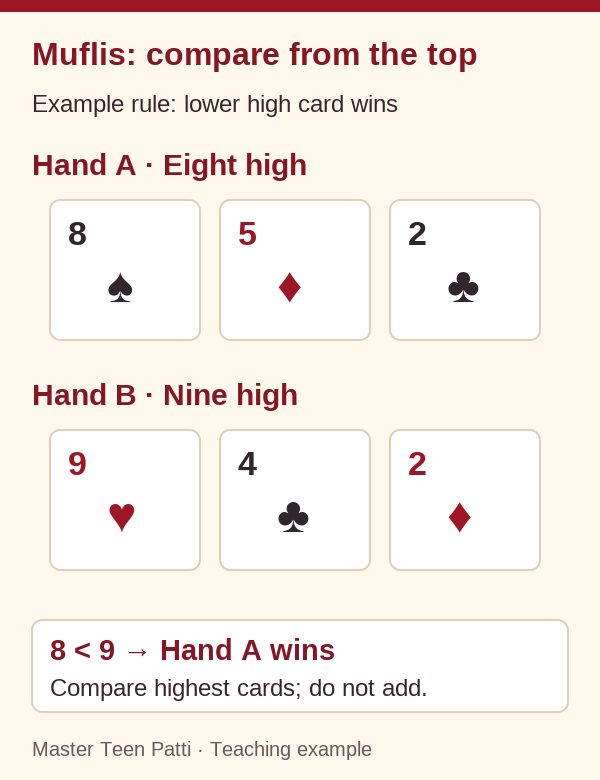
Compare 8♠–5♦–2♣ with 9♥–4♣–2♦. Neither hand is a pair, sequence or colour. Sort each hand from its highest card down: 8–5–2 and 9–4–2. Under the stated low-hand comparison, the eight-high hand wins because eight is lower than nine. You do not need to inspect the second card once that first difference decides it.
Now compare 8♠–5♦–2♣ with 8♥–6♣–3♦. The highest cards tie, so move to the second cards. Five is lower than six; the first hand wins again. Do not add the ranks together. Muflis comparison in this example is an ordered comparison, not a contest for the smallest total.
Practise comparing one rank at a time.
Compare reversed rankings with a variant that changes card values.
Why a very small pair can still lose
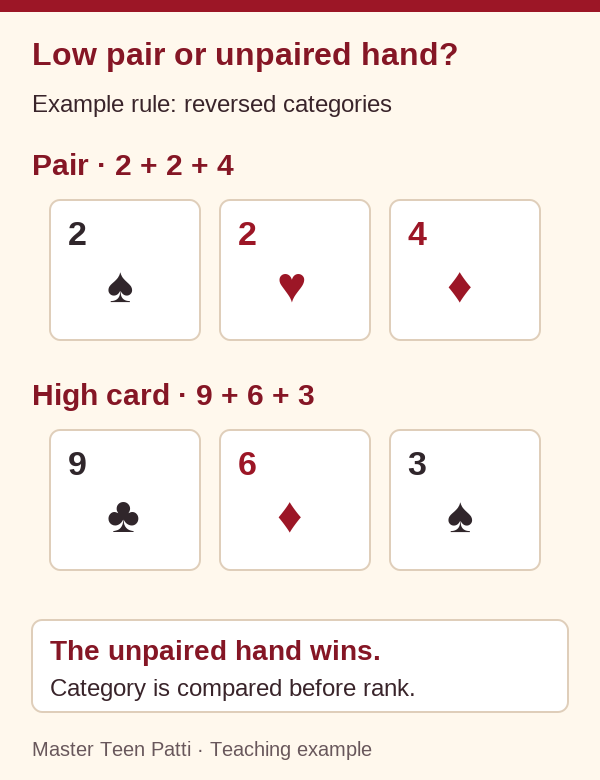
Take 2♠–2♥–4♦ and compare it with 9♣–6♦–3♠. The first hand contains a pair. The second is an ordinary high-card hand. In the reversed-category version, category comes before individual rank, so the unpaired hand wins even though its highest card is a nine. Looking only for the smallest printed number would give the wrong answer.
Try the same comparison under ordinary Teen Patti and the outcome reverses: the pair wins. Laying these two results beside each other is a useful way to learn what changed. The cards did not become different cards. The rule deciding which category is preferred changed. Always name the category before comparing values inside it.
Aces, sequences and colours need extra care
An ace is not automatically the best low card merely because a game is called Muflis. Under an ace-high agreement, an ace can make an unpaired hand comparatively high. Under an ace-low agreement it behaves differently. Write the chosen value explicitly; the symbol on the card cannot tell you which convention the table selected.
Also check whether a low-looking run such as 2–3–4 still counts as a sequence. In a full category reversal, a sequence remains a category even when its ranks are small. Likewise, three low cards of one suit may form a colour. Keep your first practice examples mixed-suit and nonconsecutive, then introduce combinations only after the basic comparison is clear.
Swipe across to see all columns.
| Example hands | First difference | Result under this guide’s rules |
|---|---|---|
| 8–5–2 vs 9–4–2 | Highest card: 8 vs 9 | 8–5–2 wins |
| 8–5–2 vs 8–6–3 | Second card: 5 vs 6 | 8–5–2 wins |
| Pair of twos vs unpaired 9–6–3 | Category: pair vs high card | Unpaired 9–6–3 wins |
Use a score sheet to explain a result
A useful practice sheet needs three columns: the two hands, the rule used and the first deciding difference. For the eight-high versus nine-high example, the deciding difference is simply “highest card: 8 below 9”. For the pair example, write “category: high card preferred to pair”. These notes are short enough to check at a glance.
Do not write that a hand is “lucky”, “safe” or “certain to win”. The sheet explains a comparison of known cards, not the unseen hands in a live round. Deal a few fresh examples face up and let a second person verify them. If you disagree, locate the rule that differs rather than arguing from the final answer alone.
Do blind, seen and sideshow disappear?
Changing the preferred hand does not, by itself, tell you how turns work. A Muflis table can have its own blind and seen limits, request rules and ending conditions. Keep those action rules separate from the ranking chart. You need both to understand what happened in a round.
Suppose you have correctly compared two practice hands but one participant had already packed. That comparison cannot bring the packed player back into the round. Similarly, a correct ranking does not make a sideshow request automatically available. Learn the ordinary action terms first, then check which ones the selected variation keeps. A familiar name is not a complete rules document.
What to check before selecting a Muflis table
Read the table description before joining. Look for its hand order, ace rule, treatment of combinations, tie handling and whether a no-stakes learning option exists. If any of these are unclear, pause rather than filling the gaps with a rule from another website. A variation is easier to learn when its decisions are predictable from written rules.
This page is a knowledge guide. It does not confirm that Muflis is available in the APK linked on this website. For that, use the actual app’s current game list and rules. Once you can explain the three worked comparisons above, move back to the standard hand-ranking guide and compare the two systems. That contrast is the part worth remembering.
Sources & scope
Further reading checked on 22 October 2026.
Editorial topic

Aarav Sethi
Aarav explains Teen Patti hand rankings with clear card comparisons, showing which ranks matter and where a table-specific rule changes the answer.