

Illustration for this guide; not an app screenshot.
Three players are still in the round. One asks a neighbour for a sideshow, two hands are compared, and one player packs. The remaining player has not won the pot yet. That last detail is easy to miss when you are watching your first game. A sideshow settles a comparison inside a round; a final show settles the round itself. Here is how to keep those two events separate.
What a sideshow actually decides
In the common form described here, an eligible seen player asks the previous eligible player for a private comparison. An accepted request leads to a hand comparison, with the weaker hand leaving the round. The rest of the table continues. The exact eligibility, payment and tie rules belong to the table, so read those before trying to use the action.
Think of the result as removing one participant, rather than awarding the whole pot. If A and B compare while C is still active, the surviving hand still has C to contend with. A better hand than B is not necessarily a better hand than C. You cannot infer C’s cards from a comparison C never joined.
Check the turn, the player and the request
Before a sideshow, identify whose turn it is, whether the requester has seen their cards and which opponent the rules allow them to approach. “The previous player” is not an invitation to choose whichever person looks easiest to beat. A packed seat or a blind player may change what is available under the table’s rules.
Separate a request from an accepted comparison. If you are learning with physical cards, use a spoken “accepted” before either hand is exposed. On an app, read the action and confirmation messages rather than assuming a tap succeeded. A disabled button may simply mean the action is unavailable at that moment. It does not by itself indicate an installation problem.
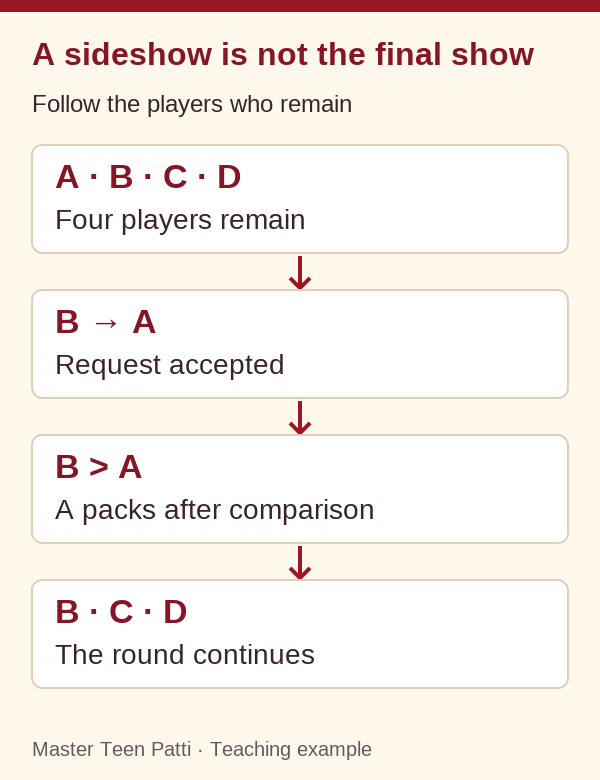
A four-player example, without real stakes
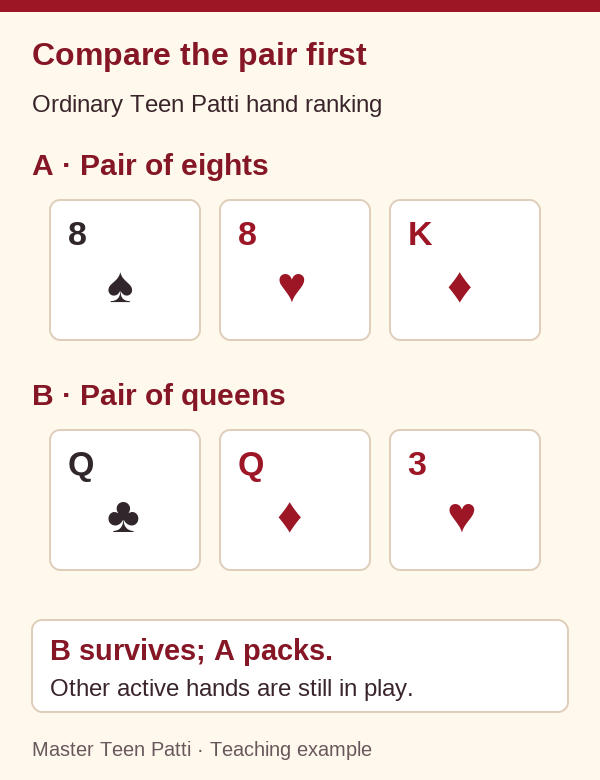
Put four names on paper in turn order: A, B, C and D. Assume the practice rules allow B, who is seen, to ask A for a sideshow. A accepts. Give A a pair of eights and B a pair of queens. Under ordinary Teen Patti pair comparison, B’s pair is higher, so A leaves this practice round.
Now cross out A, not C or D. Keep B, C and D on your sheet. Nothing in the comparison has ranked B against those other hands. This small exercise catches a common reading error: treating the word “win” beside a comparison as proof that the full round has ended. Always identify which event the message describes.
If the other player says no
A refusal does not reveal the opponent’s hand. It also does not turn your own hand into a winning one. Under a request-and-acceptance format, no accepted private comparison has occurred, so do not expose cards merely because you asked. Continue according to the table’s next-action rules.
Avoid adding a story to the refusal. “They declined because they have a trail” is a guess, not an observed result. For a beginner’s practice record, write only “requested” and “declined”. If a house game limits repeated requests or requires a payment before asking, agree that before the deal. Do not invent a refund or a free repeat attempt after the fact.
Equal hands need a stated rule
First establish that the hands really tie. Two pairs of the same rank may still be separated by the third card. A pair of tens with an ace is not equal to a pair of tens with a king under the usual comparison. Suits alone should not be used as a tie-breaker unless the selected rules explicitly rank them.
If all deciding ranks match, consult the sideshow tie rule. Some formats make the requester pack; other table agreements can differ. Do not carry that convention into every final show. Practise one genuinely equal comparison before playing a full practice round, and write down who leaves and why. This is a rules check, not a prediction technique.
Work through equal-category comparisons.
Swipe across to see all columns.
| Question | Sideshow | Final show |
|---|---|---|
| What is compared? | Two eligible players’ hands | The remaining hands under the table rules |
| What happens next? | One comparing player may leave; others stay active | The final comparison settles the round |
| What must be checked? | Request eligibility, acceptance and ties | Who may ask, the cost and ties |
Sideshow and final show side by side
Ask two questions: how many players remain, and what will this comparison decide? A sideshow can occur while other participants remain in the round. A final two-player show compares the remaining hands to settle the pot under the table’s show rules. The amount required and the blind/seen eligibility should be checked separately.
Use different labels in your notes: “B survives sideshow” and “B wins final show”. Those sentences record different results. If only B and C are left after earlier players pack, the next comparison is governed by the two-player situation. The private comparison you watched earlier is not a reusable shortcut for every later turn.
Read the final-show conditions and the named equal-hand rule.
Learn the comparison before watching the animation
For a practice session, lay the hands flat and name the category first. Then compare the deciding rank. A pair loses to a sequence in ordinary Teen Patti regardless of how striking the pair’s artwork looks. When both hands are pairs, compare the pair before looking at the spare card.
Only after naming the result should you check a displayed animation or message. This makes it easier to describe a disagreement accurately: “Both hands were pairs; these were the ranks” gives a reviewer something concrete. “The animation looked wrong” leaves out the deciding information. Keep the hand-ranking guide nearby until the comparison order becomes familiar.
Before trying it in an app
This guide explains a game action; it does not confirm that the selected APK offers a particular sideshow button, request limit or table mode. Read the installed product’s own rules. If its description differs from a home game, use the rules for that product rather than combining both versions.
For a disputed result, record the round identifier if one exists, the visible hand ranks and the exact message. A public comment is not a place for passwords or account recovery codes. If you are still learning the terminology, return to blind versus seen and the hand-comparison examples first. Understanding the action is more useful than memorising a button position that may change.
Sources & scope
Further reading checked on 22 October 2026.
Editorial topic

Aarav Sethi
Aarav explains Teen Patti hand rankings with clear card comparisons, showing which ranks matter and where a table-specific rule changes the answer.