
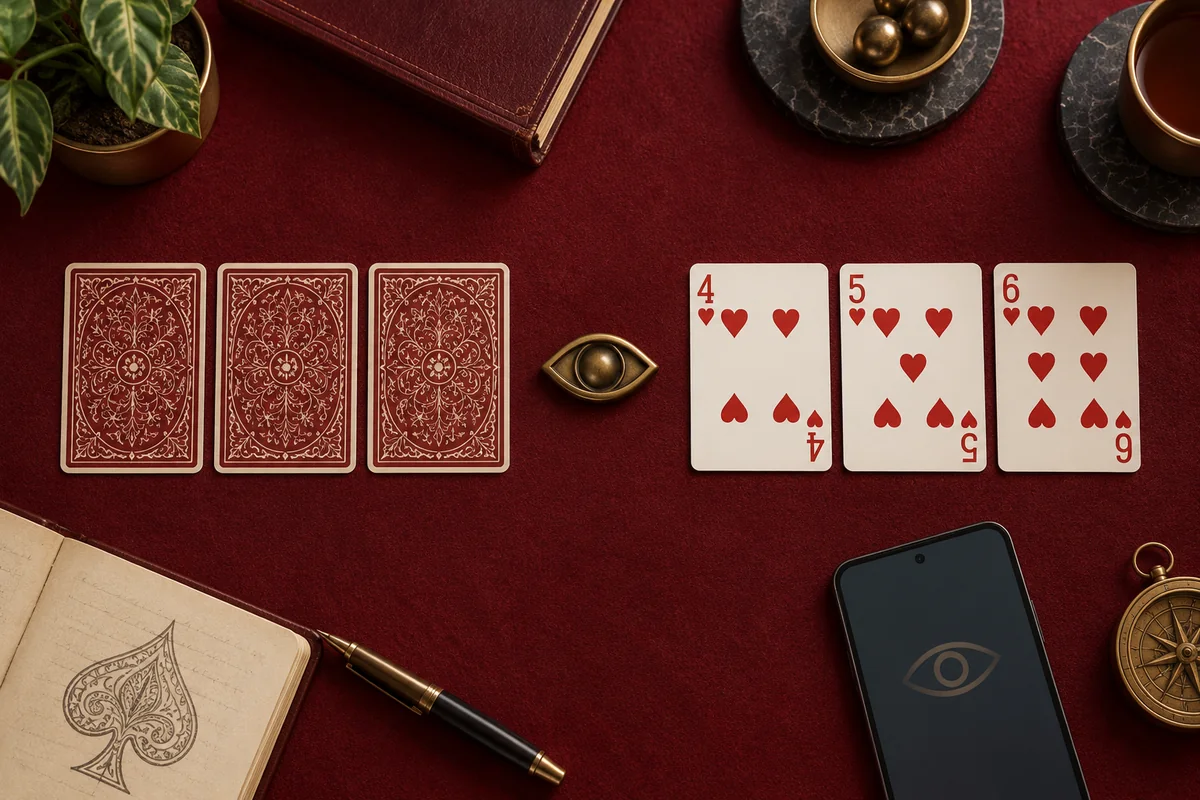
Illustration for this guide; not an app screenshot.
Blind and seen describe a player’s relationship to their own cards. They are not two hand categories and they are not labels for a weak or strong hand. Start with that distinction, then separate three questions: what you know, which action is available and how a hand is compared. The examples below are teaching situations, not screenshots or confirmed features of the Master Teen Patti app.
The basic distinction
A blind player has not viewed their cards; a seen player has. A player can begin blind and later look. In the ordinary rules described by the sources, looking moves that player into the seen state. Closing the card display afterwards does not undo the information already learned. Check the table’s instructions for when viewing is permitted.
The same three cards, before and after looking
Imagine that a hand contains 4♥, 5♥ and 6♥. While those cards are hidden from their holder, the player is blind. After looking, the player is seen and can recognise a pure sequence. The three cards have not changed. If another hand is compared with this one, use the hand-ranking rules; neither the word “blind” nor the word “seen” replaces those rules. The illustration contrasts knowledge of a hand, not its strength before and after a button press.

An action amount is a different question
Published rules commonly apply different contribution conditions to blind and seen players. That does not mean a number from one app can be copied into another. Read the current table’s displayed action, required amount and limit together. If two players see different available actions, first check their states and the table rules; a screenshot of only one number does not explain the whole situation. This guide does not prescribe a stake or recommend which state to choose.
Separate the chance of receiving a hand from the chance of winning.
Seen does not mean everyone can see your cards
Reading your own cards and comparing them with another player are separate events. A show or sideshow has its own eligibility conditions. For example, the published Octro and TeenPatti Royale guides describe comparison actions separately from simply viewing a hand, and their detailed table conditions are not identical. Do not assume that becoming seen immediately enables a comparison with any opponent. Use the rules for the table you are actually reading.
Check your understanding
Try three quick questions. You look at a pair: are you now blind or seen? Seen; “pair” is the hand category. You hide the cards again: has the information disappeared? No. You see a comparison button on somebody else’s screen: is it necessarily available to you? No; the situation and rules may differ. Keeping player state, hand category and permitted action separate makes the rest of the rulebook easier to read.
Use a state card for each seat
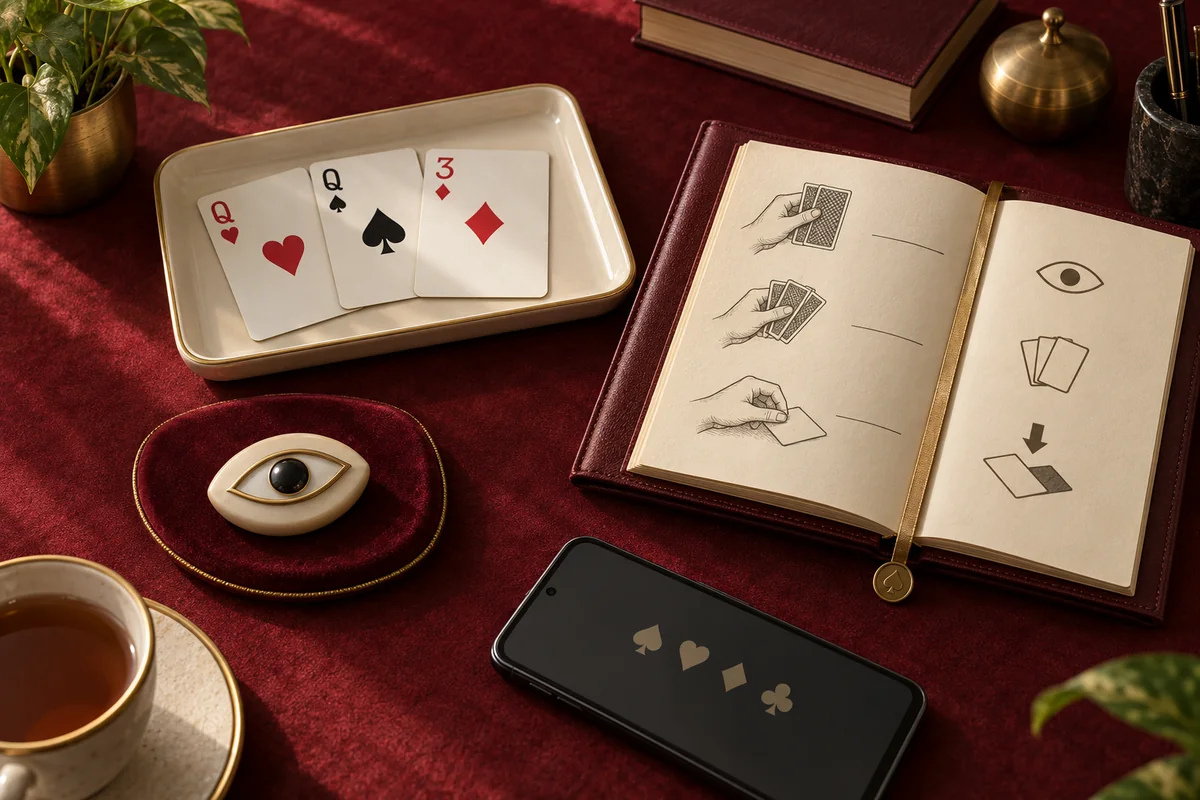
For a paper exercise, give each imaginary seat a small state card. Write whether the seat is active and whether its holder has viewed their hand. Keep the actual hand on a separate card. This physical separation makes it harder to confuse the information label with the strength of the cards. You can change a state label without changing the three cards underneath it.
Start with A and B both active and blind. Let A look at a hand containing 4♥, 5♥ and 6♥. Change only A’s viewing label. B remains blind in the example, and neither label tells you what B holds. Now imagine that A puts the hand card face down again. Ask whether the viewing label should change back. The answer follows from what A already learned, not from which side of the paper is currently visible.
Next, in a separate example, let B look at a pair. B becomes seen just as A did, despite holding a different category. This demonstrates that “seen” is not a reward for a stronger hand. You can use the same worksheet to explain the idea in Hindi or English without inventing a new translation for every card category. The exercise records knowledge and participation; it does not recommend which state to select in a real game.
Explain an unavailable action without guessing a feature
Suppose a friend says, “I am seen, so why can I not compare with that player?” The word seen answers only whether the friend viewed their own cards. It does not, by itself, answer every eligibility question about comparison. A useful explanation starts by identifying the requested action, the number of active seats and the applicable rule text. Do not infer the missing conditions from the label alone.
Use a note with two columns: what is known and what must be checked. Known facts might include that a player viewed their cards and that a particular control is not available. Questions might include which comparison the control represents and what the table requires before showing it. A missing control is not enough evidence to announce that the APK is broken, that an account is restricted or that a feature is supported. Those are separate claims requiring product-specific information.
This same habit helps when comparing guides. If one source describes a sideshow condition differently from another, identify which game and table each source describes. Do not combine the most convenient parts into an imaginary universal rule. Keep the shared definition of blind and seen, then attribute the detailed action conditions to the relevant rules. A clear beginner explanation tells the reader exactly where general vocabulary ends and a specific table’s instructions begin.
Check final-show eligibility for the two remaining player states.
Sources & scope
Further reading checked on 12 October 2026.
Editorial topic

Diya Kapoor
Diya works on game terminology and English–Hindi explanations, connecting words such as boot, chaal and pack with the actions they describe.