

Illustration for this guide; not an app screenshot.
Once two hands share a category, the next question is which ranks decide the result. The examples below use the common classic order, no jokers and no suit-based tie breaker. Read your table’s rules when a variant changes those assumptions.
Pairs: compare the pair before the spare card
Take J♠ J♥ 3♣ against 10♠ 10♥ A♣. The jacks win because the paired rank is higher. The ace does not rescue a lower pair. Next compare J♠ J♥ A♣ with J♦ J♣ K♠. Both pairs are jacks, so the unpaired card decides: ace beats king under the usual high-card order.
Unsure which category wins? Compare sequence and colour first.
Colours: read the ranks in descending order
Compare A♠ J♠ 6♠ with A♥ 10♥ 9♥. The aces tie; jack beats ten, so there is no need to use the last card. Both hands are colours rather than pure sequences because their ranks are not consecutive. If the first two ranks matched, only then would the third rank decide.
High card: sort first, then compare
K♠ 9♥ 4♣ beats K♥ 8♣ 7♦ in this example. The kings match, but nine beats eight. Adding card values is not the comparison rule: a higher sum can still lose. Sorting both hands from high to low makes the deciding position visible and prevents this common mistake.
Equal ranks and unusual sequences
If every relevant rank matches, do not invent a winner from the suit or the order in which cards were dealt. Read the table’s tie and show rules. Ace-containing sequences are another rule-dependent case, so these examples deliberately avoid ranking A–2–3 against A–K–Q. Decide the variant before comparing the cards.
Check the round rules before applying a table-specific exception.
Pair worksheet: decide what to compare first
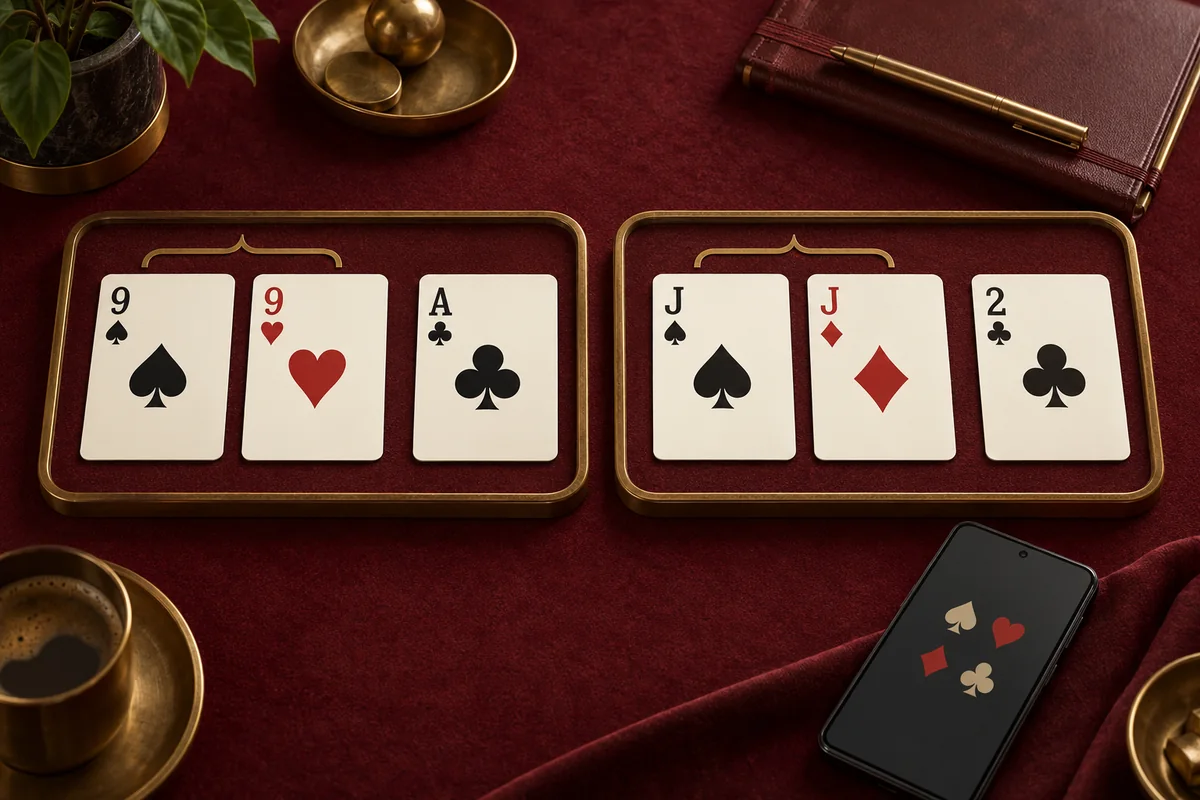
Use these fictional hands for a written exercise: A has 9♠, 9♥, A♣, while B has J♠, J♦, 2♣. Circle the paired cards before comparing anything else. A’s paired rank is nine and B’s is jack. Under the usual pair comparison, the jacks decide the result; A’s spare ace does not get the first vote. Writing the pair as a unit prevents one eye-catching spare card from dominating the explanation.
Now start a separate example. A has 9♠, 9♥, A♣ and B has 9♦, 9♣, K♠. The paired ranks match, so the spare cards become relevant. This time the ace matters because the comparison reached that step. The useful lesson is not “an ace wins” or “an ace never matters”. It is that the correct deciding card depends on which earlier comparison has already been resolved.
Record the result in two sentences: name the matching category, then name the first deciding rank. Ask another reader to reproduce the answer from those sentences without seeing your initial guess. If the explanation jumps straight to a spare card in the first example, return to the paired ranks. Keep this as a classification exercise, separate from any advice about continuing or leaving a game.
Colour worksheet: sort both hands before comparing
Take A♥, 10♥, 4♥ against A♠, 9♠, 8♠. Both hands are colours because each uses one suit and neither forms a sequence. Write their ranks in descending order: A–10–4 and A–9–8. The aces match. The next ranks, ten and nine, decide the comparison. The lower eight on the second side does not overtake that earlier difference. Comparing one position at a time is easier to explain than adding card values together, which is not the procedure described here.
Try a second, separate comparison: K♥, 8♥, 6♥ against K♣, 8♣, 5♣. The first ranks match and the second ranks match, so you reach the last card. Say each step aloud: king against king, eight against eight, then six against five. This example makes the third-card step visible without suggesting that the third card always matters.
Finally, write A♦, J♦, 7♦ against A♣, J♣, 7♣. The rank lists match throughout. Your worksheet has reached the limit of rank comparison. It has not discovered a reason to prefer diamonds over clubs. Consult the applicable equal-hand rule rather than making a suit hierarchy up. An honest “the ranks are tied; the table rule decides the next step” is a complete and useful intermediate answer.

Catch a category mistake before doing a tie-break
A tie-break worksheet only helps after the categories have been identified correctly. Compare 5♥, 6♥, 7♥ with K♠, 9♠, 3♠. Calling both hands colours would miss the consecutive ranks in the first hand. That first hand meets the more specific pure-sequence category. You should return to the category order rather than continue a colour-versus-colour comparison. Sorting ranks is useful, but it cannot replace recognising the complete pattern.
A compact review has four questions. Have you written all three ranks and suits? Have you checked for matching ranks and consecutive ranks? Are the two categories actually the same? If they are, what is the first relevant difference within that category? Answering in this order lets another person see where a disagreement started. It also explains why two readers can agree on every card but still give different answers: one may have mislabelled the category.
For independent practice, make a new example by changing one card, then describe exactly which step changes. If changing a suit removes a pure sequence but preserves a sequence, state that distinction. If changing a spare card leaves two unequal pairs in the same order, explain why the result does not change. These small variations test understanding more effectively than memorising the winner of one picture.
Sources & scope
Further reading checked on 12 October 2026.
Editorial topic

Aarav Sethi
Aarav explains Teen Patti hand rankings with clear card comparisons, showing which ranks matter and where a table-specific rule changes the answer.