
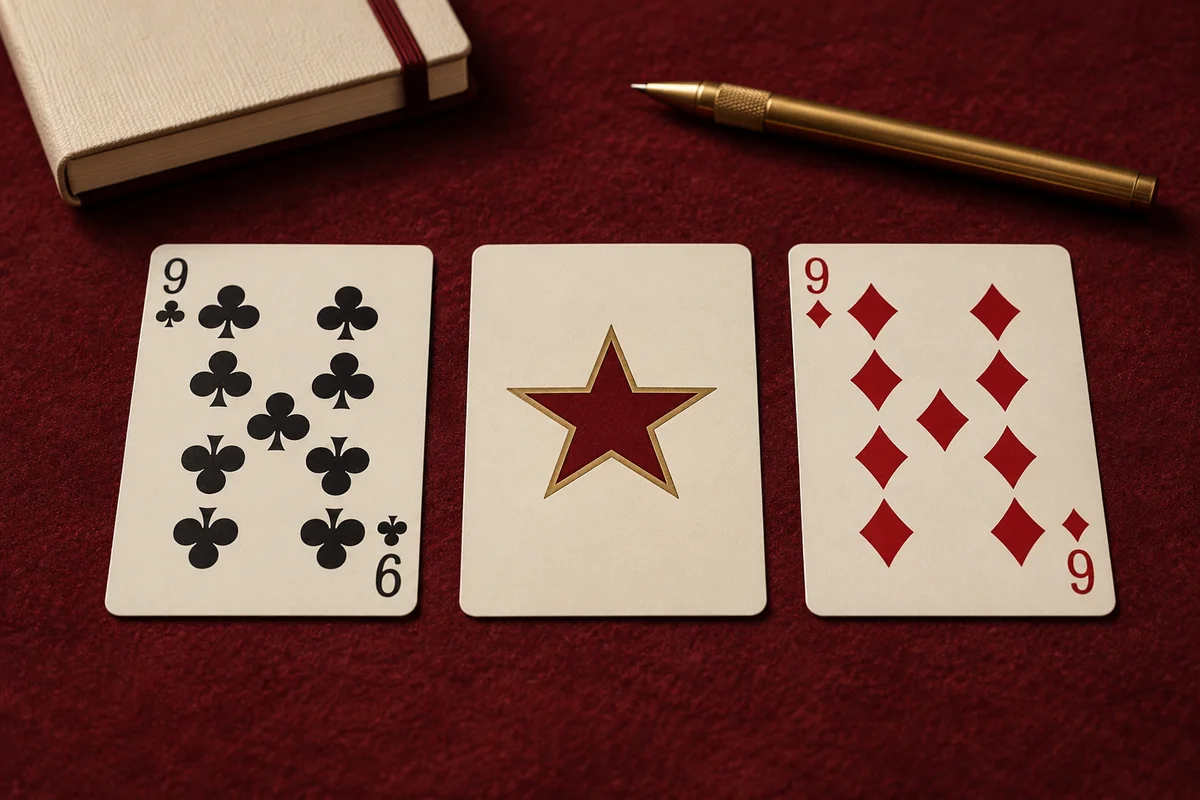
Illustration for this guide; not an app screenshot.
You are dealt 9♣, 9♦ and a card that the table calls a joker. Is that still a pair? If the wild card may substitute freely, it can represent another nine and make a trail. The important step is naming the replacement, not simply saying “I have a joker”. The examples below separate the printed card, the rule that makes it wild and the completed hand you compare.
What does joker mean in Teen Patti?
A wild card is allowed to represent another card under the selected rules. It need not have a jester printed on it. A table might nominate a rank, use each player’s lowest card or specify several fixed ranks. Those choices do not produce the same hands, so “Joker Teen Patti” is a family label rather than a complete rulebook.
For our first two examples, every six is wild and one wild card may take any needed rank and suit. Ordinary high-hand categories apply. This is a teaching rule, not a statement about an available Master Teen Patti app mode. Keep the rule visible while working through the cards; changing it halfway through an example changes the answer.
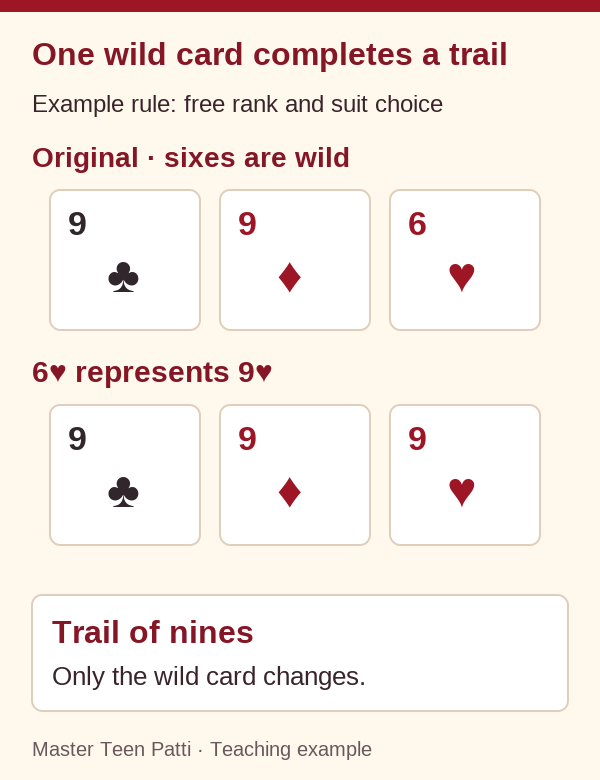
A pair plus one wild card: name the trail
Place 9♣, 9♦ and 6♥ on the table. The six is wild in this exercise. Let it represent 9♥, giving 9♣–9♦–9♥: a trail of nines. The original six has not physically changed, but the hand is evaluated using its allowed replacement. Write both versions down so another reader can check the substitution.
Now try using the six as an ace. That leaves only a pair of nines with an ace beside it. Under ordinary high-hand rankings, the trail is the stronger interpretation. A wild card does not automatically become an ace; it takes the permitted value that makes the best category. Compare complete hands rather than choosing a replacement because its printed rank sounds higher.
Fill a suited gap without changing the other cards
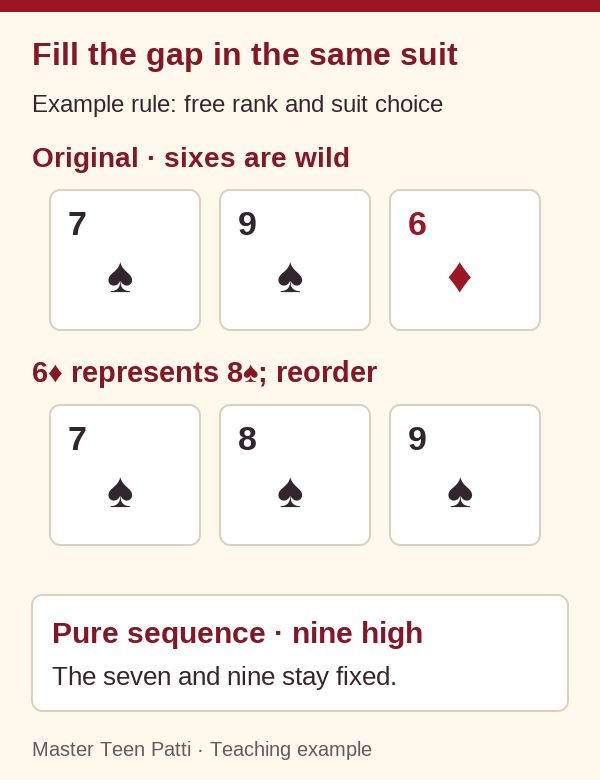
Use 7♠, 9♠ and the wild 6♦. Replace only the six with 8♠. The completed hand is 7♠–8♠–9♠, a pure sequence. Both rank and suit matter: an eight of hearts would make an ordinary sequence instead. The non-wild seven and nine keep their original suits throughout the exercise.
Could the wild card make a trail here? No. The two non-wild cards have different ranks, and one replacement cannot turn both into matching cards. This is a useful way to check a claimed hand: cover the joker, look at the fixed cards and ask what one missing card can actually complete. Do not silently alter a second card to reach a stronger category.
AK47: which cards become wild?
A common AK47 agreement makes aces, kings, fours and sevens wild, in all four suits. That is four ranks times four suits: sixteen wild-designated cards in a full 52-card deck. It does not mean sixteen extra cards are added. Compare that with our sixes-wild example, which designates only four existing cards.
Take A♣, 7♦ and Q♠ under the stated AK47 rule. The first two cards are wild; the queen remains fixed. They can represent Q♣ and Q♦, completing a trail of queens. Under sixes-wild rules, none of those three cards is wild, so the same printed cards have a different meaning. Identify the variant before naming the hand; the letters AK47 are not a separate hand category.
Swipe across to see all columns.
| Rule | What is wild? | Check first |
|---|---|---|
| Sixes-wild example | All four sixes | Permitted ranks and suits |
| Common AK47 | All aces, kings, fours and sevens | Natural-hand and tie treatment |
| Lowest joker | A card nominated from each hand | Ace value and tied lowest cards |
Lowest joker and an exposed indicator are different
Suppose a game calls each player’s own lowest card wild. A hand of 3♦, 8♣ and J♥ would nominate the three if the agreed rank order places it lowest. Another player’s hand may nominate a different rank. That differs from turning over a shared indicator and declaring one rank wild for everyone. You cannot infer the second player’s joker from the first player’s cards.
Before evaluating this kind of hand, settle what happens with equal lowest ranks and how an ace is treated. If two threes are jointly lowest, does one card become wild or both? A short variant name does not answer that. Keep the original nomination separate from the value later assigned to the wild card; otherwise the identification process can become circular.
Does a natural hand beat a joker-made hand?
Compare a natural trail of eights with a wild-assisted trail of nines. If the agreed rules compare completed categories and ranks normally, the nines win because both hands are trails and nine outranks eight. The presence of a joker does not erase the need to compare the finished ranks. “Has a wild card” is not itself a higher category.
Now compare two completed trails of nines. Some rule sets may treat a natural hand specially; others compare only the completed hand and apply their tie procedure. Ask which rule is written before deciding. A diagram showing a valid replacement establishes what the hand can form, but does not settle every table’s tie policy or the outcome of an entire round.
Practise with a three-column note
Use a sheet with three headings: original cards, permitted replacement and completed category. Start with the two illustrated hands. For 9♣–9♦–6♥, enter “6♥ represents 9♥” and “trail of nines”. For 7♠–9♠–6♦, enter “6♦ represents 8♠” and “pure sequence, nine high”. The written replacement makes the reasoning visible.
Next, change only the wild rule to AK47 and evaluate the original cards again. In the first hand none is wild, so it stays a pair of nines. In the second, the seven becomes wild while nine and six remain fixed; it can represent another nine to make a pair. Notice that the best answer changed without replacing the physical cards. That is the purpose of the exercise.
A short checklist before choosing a joker table
Read the wild-card selection, allowed substitutions, hand order, natural-hand treatment and tie rule. Check whether the selection stays fixed for the deal. A changing or revolving-joker mode needs its own timing instructions; the fixed-rule examples here should not be stretched to cover an unexplained change. Printed jokers also change the deck model, so do not reuse a no-joker probability table for them.
If a table description leaves one of these points unclear, resolve that point before comparing hands. You can practise with face-up cards without staking money. This page explains a rule family; it does not confirm that Joker or AK47 is included in the linked APK. Use the actual product’s game list and rules to establish what is available.
Sources & scope
- TeenPatti Royale support: variations
- Teen Patti: variants and card values
- Teen Patti Fan: joker rule families
Further reading checked on 22 October 2026.
Editorial topic

Kabir Anand
Kabir covers APK sources and file information, explaining the difference between a working link, matching file bytes and evidence of publisher identity.