
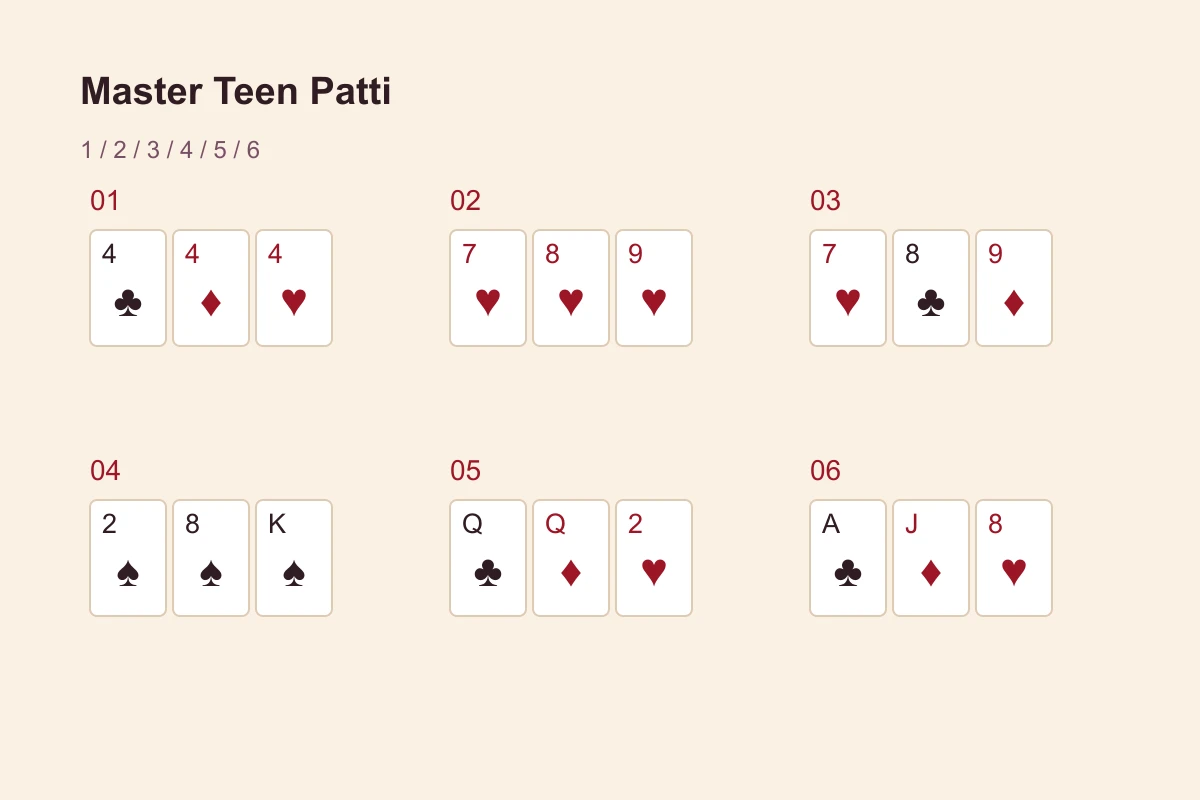
Illustration for this guide; not an app screenshot.
When two Teen Patti hands look strong, compare the hand category first. An ace does not automatically win, and matching suits do not automatically make a sequence. This guide uses small, repeatable comparisons so you can explain the result rather than memorise a slogan. The examples describe common classic rules; a table’s published rules take priority for variants, ace ordering and ties.
Start with the six-category order
In the common high-hand order, trail comes first, followed by pure sequence, sequence, colour, pair and high card. Compare the category before the highest individual card. For example, 4♣ 4♦ 4♥ is a trail. It beats A♠ K♠ Q♠, even though every rank in the second hand is higher than four. The second hand is a pure sequence, one category lower. Keep this distinction in mind whenever a hand contains an ace.
Pure sequence, sequence and colour
Ask two separate questions: are the ranks consecutive, and are all three suits the same? Both answers yes means pure sequence: 7♥ 8♥ 9♥. Consecutive ranks with mixed suits means sequence: 7♥ 8♣ 9♦. One suit without consecutive ranks means colour: 2♠ 8♠ K♠. The mixed-suit sequence beats that colour. A colour is not stronger simply because its king looks more impressive than a nine.

Compare two pairs without missing the third card
For a pair, compare the repeated rank first. Q♣ Q♦ 2♥ beats J♠ J♥ A♦ because queens form the higher pair; the ace cannot rescue the lower pair. If both pairs are queens, compare the remaining card: Q♣ Q♦ 9♥ beats Q♠ Q♥ 5♦ under the common rule. Do not add the three card values together. A pair is evaluated by its repeated rank and then its unmatched card, not a total score.
High card and colour: read all three ranks
When the categories match, sort each hand from highest rank to lowest and compare one position at a time. For high card, A♣ J♦ 8♥ beats A♦ J♠ 6♣: the aces tie, the jacks tie, then eight beats six. The same comparison method is commonly used between two colours. Suits are not a universal tie-breaker. If all three ranks tie, read the table’s tie and show rules instead of inventing a suit order.
Aces and variants need a separate check
A-K-Q and A-2-3 are recognised sequences in many rule sets, but their relative order is not something to infer from the pictures. Confirm the published order before a round. Do not treat K-A-2 as a sequence unless the specific rules explicitly allow it. Muflis and joker games can alter the usual objective or construction of a hand. This website’s classic ranking table does not confirm that any of those modes is available in the linked Android package.
A quick practice check
Compare 5♣ 6♦ 7♥ with 2♥ 9♥ A♥. First identify sequence versus colour; the sequence wins in the common order. Next compare K♣ K♦ 3♥ with Q♣ Q♦ A♥; the kings win because the pair rank is considered first. Finally compare A♣ 10♦ 7♥ with A♦ 10♠ 7♣. The ranks match; the next step is the table’s tie rule. The useful habit is to state the category, show the first differing rank and stop when the rules no longer support a conclusion.
Sources & scope
Sources checked on 9 October 2026. General guidance is distinct from features or behaviour verified in the APK.
About the author

Aarav Sethi
Aarav explains Teen Patti hand rankings with clear card comparisons, showing which ranks matter and where a table-specific rule changes the answer.