
Illustration for this guide; not an app screenshot.
How likely is a pair in Teen Patti? In the 52-card model below, exactly 3,744 of 22,100 possible hands contain one pair: about 16.94%. That is a chance of receiving a category, not a chance of winning a round. This guide shows how the numbers are counted, why the categories must not overlap and what changes when you know which cards have already been dealt.
Which rules does this probability chart use?
Start with one complete deck: thirteen ranks, four suits and no printed jokers. Every set of three distinct cards is equally likely. A run may use A–2–3 or Q–K–A, but K–A–2 is excluded. A pure sequence is a run of one suit; the separate sequence category excludes those suited runs. Colour means one suit without a run. A pair contains exactly two matching ranks.
These definitions are the boundary of the calculation. Whether a table places A–2–3 above or below Q–K–A does not change how many valid runs exist, provided both are accepted. Removing one run, adding wild cards or changing the deck does change the counts. Match the model to the rules before using any percentage from the chart.
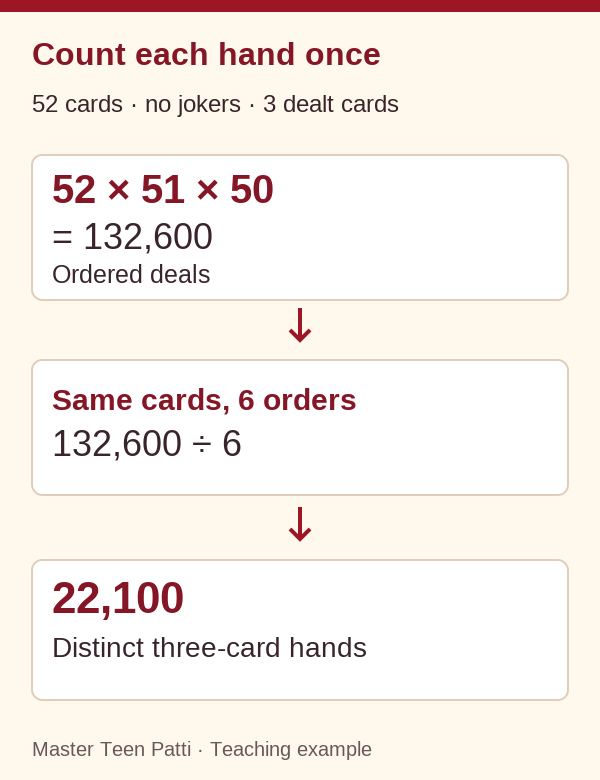
Why are there 22,100 possible hands?
Imagine choosing three cards one after another. There are 52 choices for the first, 51 for the second and 50 for the third. Multiplying gives 132,600 ordered deals. However, the same three cards can arrive in six different orders. A 6♣ followed by J♦ and A♠ is the same final hand as A♠, 6♣, J♦. Divide by six to get 22,100 distinct hands.
This is the combination written as C(52,3). It counts cards, including their suits, rather than just rank names. Three aces is not one possibility: four different aces can form four different three-card sets. Counting complete card identities is what keeps the numerator and denominator on the same basis.
Read the six hand probabilities
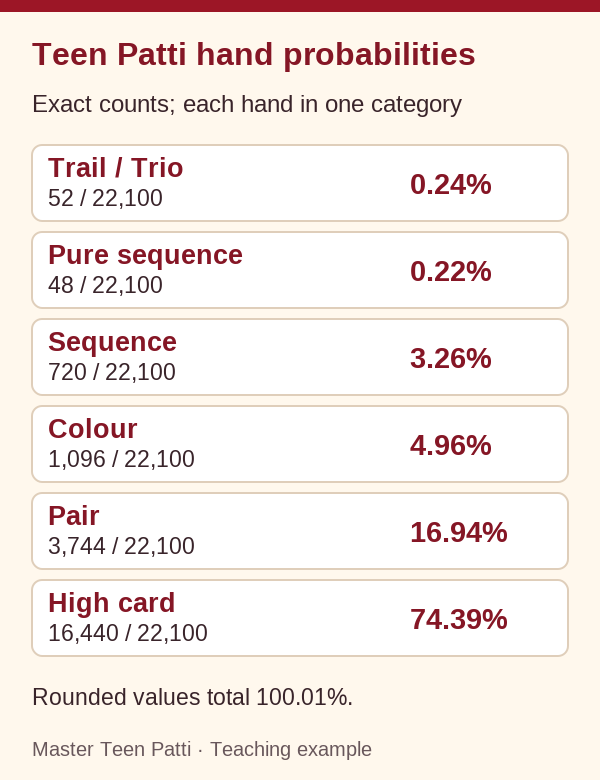
The table lists mutually exclusive categories. Each possible hand appears in one row, so the counts add to 22,100. Divide a row’s count by 22,100 and multiply by 100 to obtain its percentage. For example, 720 ordinary sequences give 3.2579%, displayed as 3.26%. The exact count is retained beside each rounded result.
Read “16.94% pair” as a statement about one randomly selected hand before its cards are known. It does not promise a pair after a particular number of attempts. Likewise, the high-card row includes many different hands, from weak ranks to ace-high combinations. A category percentage does not tell you which ranks you will receive within it.
Swipe across to see all columns.
| Hand category | Exact hands | Probability |
|---|---|---|
| Trail / Trio | 52 | 0.24% |
| Pure sequence | 48 | 0.22% |
| Sequence | 720 | 3.26% |
| Colour | 1,096 | 4.96% |
| Pair | 3,744 | 16.94% |
| High card | 16,440 | 74.39% |
Count a pair without counting a trail
Choose the paired rank in thirteen ways. Choose two of its four suits in six ways. The remaining card must come from another rank, leaving twelve ranks with four suits each: 48 choices. The multiplication is 13 × 6 × 48 = 3,744. Allowing the spare card to match the pair would incorrectly include three of a kind.
Try this with a pair of fives. The pair could be 5♣–5♦ or 5♥–5♠, among six suit combinations. The third card can be any card other than a five. Changing that spare card produces a different hand, even though the category stays pair. This small counting exercise explains why merely writing “five-five-anything” misses important distinctions.
Count runs and colours without overlap
There are twelve accepted three-rank runs under our rules. Each run has four choices of suit for each card, giving 4 × 4 × 4 = 64 suit arrangements. Four arrangements put all three cards in the same suit. Those belong to pure sequence, so ordinary sequence has 12 × 60 = 720 hands and pure sequence has 12 × 4 = 48.
For colour, choose a suit and then any three of its thirteen cards. That gives 4 × C(13,3) = 1,144 same-suit hands. Subtract the 48 pure sequences to leave 1,096 colours. The subtraction matters: a suited 6–7–8 cannot sit in both the colour row and the pure-sequence row of a probability table.
Any trail and three aces are different questions
For a trail, pick one rank and three of its four suits. The count is 13 × 4 = 52. Its probability is 52/22,100, about 0.2353%, or one in 425. If the question is specifically three aces, only four of those hands qualify. Four divided by 22,100 is about 0.0181%, or one in 5,525.
A particular set such as A♣–A♦–A♥ is narrower still: it is one exact hand. This is why search results that say “ace probability” can appear to disagree. One may mean at least one ace, another a trail of aces, and another a specified trio. Write down the event before comparing two percentages; similar wording can conceal different numerators.
Why hand odds are not your winning odds
The chart describes one hand chosen from a complete deck. After you see three cards, an opponent’s possible cards come from the remaining 49. For one opponent there are C(49,3) = 18,424 candidate hands before other information is considered. Their distribution depends on the exact cards you hold. You cannot read your chance of beating them directly from the original six percentages.
With several opponents, their hands also share the remaining deck rather than coming from separate fresh decks. In addition, a finished round depends on who stays active and which comparison rules apply. Treat “chance of being dealt a pair”, “chance my pair beats one random hand” and “chance I win this round” as three separate questions.
Read the limits of using game information to make play decisions.
Check the arithmetic before sharing a chart
Our check enumerates every unordered three-card combination and assigns it once, in category order. The six totals are 52, 48, 720, 1,096, 3,744 and 16,440. Their sum is 22,100. Because the published percentages are rounded independently, adding the displayed values gives 100.01%; that tiny difference is rounding, not an extra group of hands. The exact counts remain the reference.
Use the same checks on another chart: identify the deck, accepted runs, wild-card rule and category exclusions. Then ask whether the chart describes a dealt hand or a winning outcome. These numbers are a reproducible deck calculation, not measurements from the Master Teen Patti APK. They cannot establish an app’s dealing behaviour or predict the next deal.
Sources & scope
Further reading checked on 22 October 2026.
Editorial topic

Aarav Sethi
Aarav explains Teen Patti hand rankings with clear card comparisons, showing which ranks matter and where a table-specific rule changes the answer.