
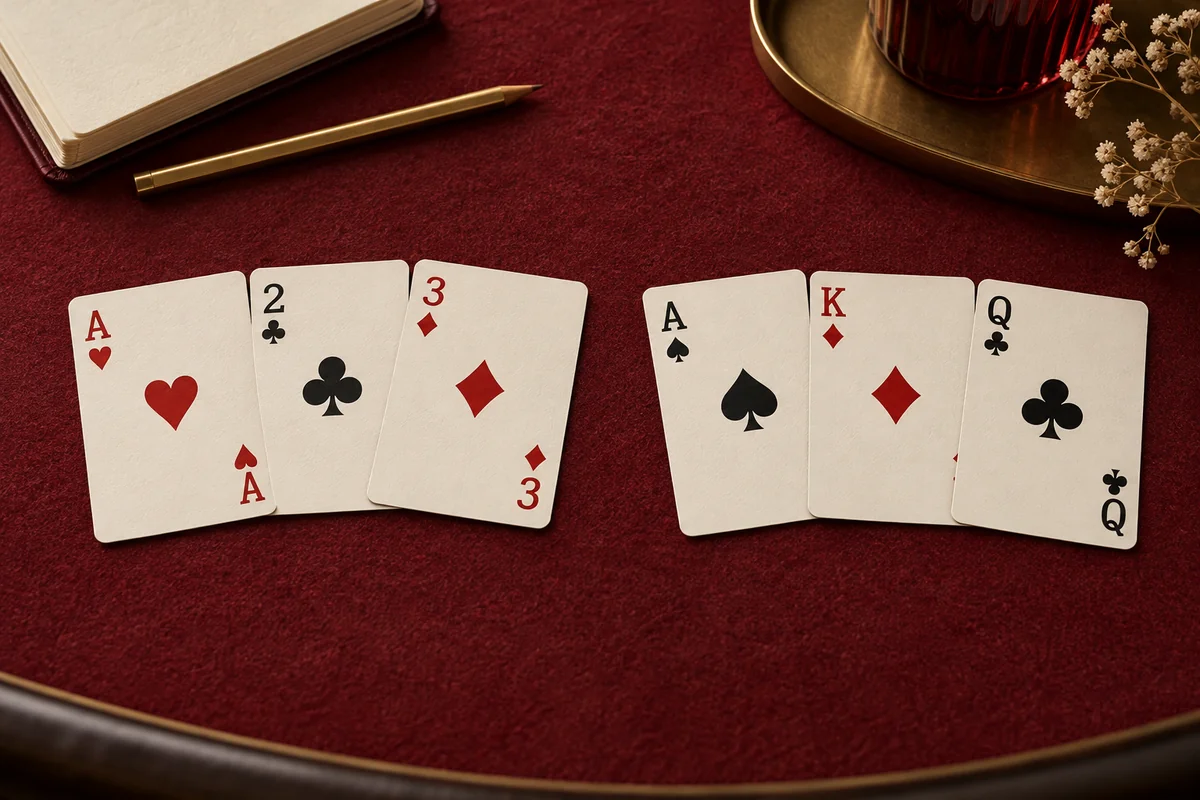
Illustration for this guide; not an app screenshot.
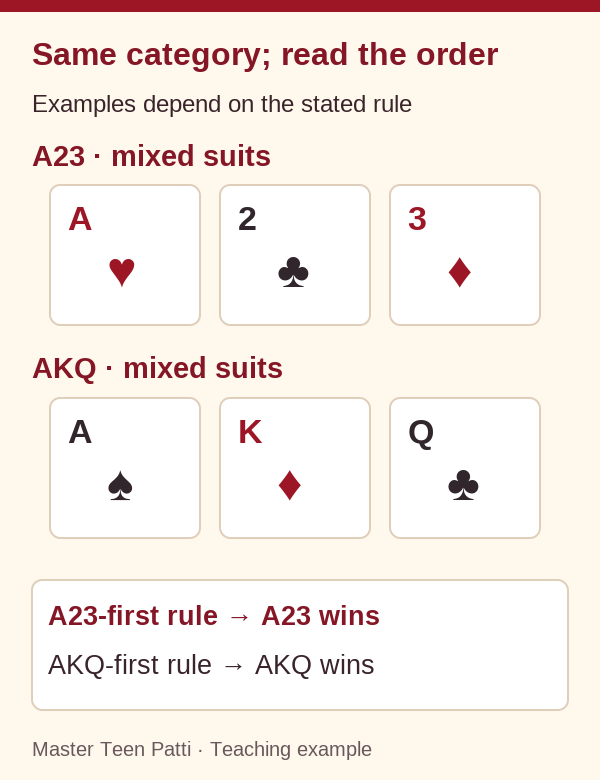
One player shows A♥–2♣–3♦. Another shows A♠–K♦–Q♣. Both have mixed-suit runs, but the cards alone do not settle the result: the table’s ace-sequence order does. Some published rules put A23 first, others place it immediately after AKQ, and others treat it as the lowest run. Here is a practical way to identify the rule and apply it without confusing suits, categories or the order in which cards were dealt.
First check that both hands are sequences
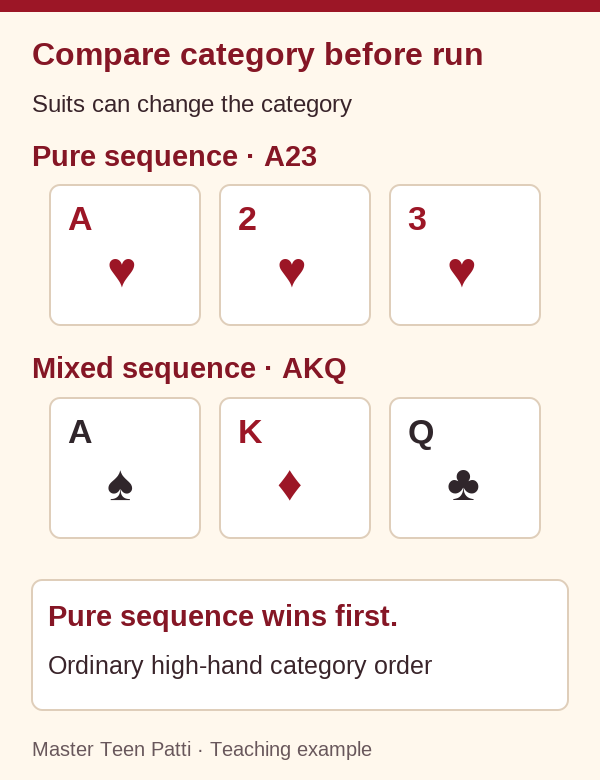
A sequence uses three consecutive ranks. A pure sequence adds the requirement that all three cards share a suit. The opening example has mixed suits in both hands, so it is a comparison within the ordinary sequence category. Changing A♥–2♣–3♦ to A♥–2♥–3♥ changes its category, not just its appearance.
Under the ordinary high-hand order used in this guide, any pure sequence beats any mixed-suit sequence. Therefore a suited A23 beats a mixed AKQ before you reach the question of which ace run is higher. Check category first and sequence order second. This prevents a familiar keyword, such as “highest AKQ”, from being applied outside the category it describes.
Three written conventions can produce different answers
Consider three clearly stated rule cards. Rule A places A23 above AKQ, followed by KQJ and the remaining runs down to 432. Rule B starts AKQ, A23, KQJ and then continues downward. Rule C starts AKQ, KQJ and the ordinary descending runs, with A23 below 432. These are comparison examples, not three settings claimed for the linked APK.
For A23 against AKQ, Rule A awards the comparison to A23; Rules B and C award it to AKQ. But B and C are not equivalent: against KQJ, A23 wins under B and loses under C. Asking only “does AKQ beat A23?” does not reveal the complete ordering. Ask where A23 sits among all the runs.
Swipe across to see all columns.
| Example rule | A23 vs AKQ | A23 vs KQJ |
|---|---|---|
| A: A23 first | A23 wins | A23 wins |
| B: A23 second | AKQ wins | A23 wins |
| C: A23 lowest | AKQ wins | KQJ wins |
AKQ, QKA and KQA describe the same three ranks
Card order on the screen is not an extra tie-breaker. A♠–K♦–Q♣ and Q♣–A♠–K♦ contain exactly the same cards. Reordering the display does not make a new hand. Search results may use QKA, KQA or AKQ for the same rank set; read them as labels until the actual cards and suits are given.
Apply the same idea to A23 and 23A. They can be two ways to write the same run. What matters is whether that rank set is accepted and how it is ordered against other accepted sets. A useful note records sorted ranks, original suits and the agreed ranking. It does not award a stronger hand to the player whose ace was displayed first.
Use KQJ to distinguish the middle and lowest rules
Suppose a rules page says AKQ is highest but says nothing else about the ace. That is not enough to place A23. Set out A♦–2♠–3♣ beside K♣–Q♥–J♦. Both are mixed-suit sequences. Under Rule B, A23 sits second and wins this comparison. Under Rule C, it sits last and loses. No cards have changed between the two examples; only the agreed list has.
This is a better diagnostic example than repeating A23 versus AKQ because it exposes the missing detail. Write a question that names the disputed comparison: “Where does A23 rank relative to KQJ and 432?” A reply containing the complete order can be checked. A reply saying only “ace is high” still leaves the run convention unclear.
Why K-A-2 is not automatically a run
Treating the ace as an endpoint does not turn the ranks into a circle. In the comparison models here, A23 and QKA are accepted endpoint runs, while KA2 is excluded. You cannot move from king through ace and continue to two merely because the ace can be used at either end in different hands.
With K♠–A♦–2♣, the mixed suits and nonconsecutive ranks make a high-card hand under these assumptions. With K♠–A♠–2♠, the same ranks form a colour because all three suits match; they still do not make a pure sequence. If a special table explicitly permits wraparound runs, that is a separate variation to document rather than a rule to assume.
Compare two suited hands using the same convention
Put A♣–2♣–3♣ against A♦–K♦–Q♦. Both hands are pure sequences. Category no longer decides the result, so consult the agreed ace-run order. Rule A selects the club A23, while Rules B and C select the diamond AKQ. The outcome follows the run convention, not a claim that clubs are stronger than diamonds.
Now compare equal rank sets in different suits, such as A♣–K♣–Q♣ and A♥–K♥–Q♥. The ace-order list cannot break that tie because both hands occupy the same position. Use the table’s actual tie procedure. Do not invent a suit hierarchy or borrow a sideshow tie rule without checking whether it applies to this kind of comparison.
A small change in ranking does not change the deck count
There are twelve distinct accepted three-rank runs when both A23 and QKA are included and KA2 is excluded. Moving A23 from first to second or last changes their order, not their membership. The counts of pure sequences and mixed-suit sequences therefore remain unchanged across our three models. Removing A23 entirely would be a different change.
This distinction is helpful when reading a probability chart beside a ranking chart. One counts how often a category can be dealt; the other decides which accepted hand outranks another. A table may share the same category probabilities while awarding an A23 comparison differently. Check both the accepted combinations and their ordering instead of assuming that matching percentages prove matching rules.
Keep a comparison note that another reader can check
Record four items: both complete hands, their categories, the accepted sequence order and the rule used for ties. A useful example is “both mixed sequences; A23 ranked second; A23 beats KQJ”. That is clearer than “my ace should win”, which omits almost every fact needed to verify the result.
If a published guide contradicts the actual table rules, do not merge the two lists into a new rule. Use the table’s documented convention for that table and keep the difference visible in your note. This article explains how to resolve the comparison; it does not identify which convention the currently linked APK implements. That requires its own current rule information.
Sources & scope
Further reading checked on 23 October 2026.
Editorial topic

Aarav Sethi
Aarav explains Teen Patti hand rankings with clear card comparisons, showing which ranks matter and where a table-specific rule changes the answer.