
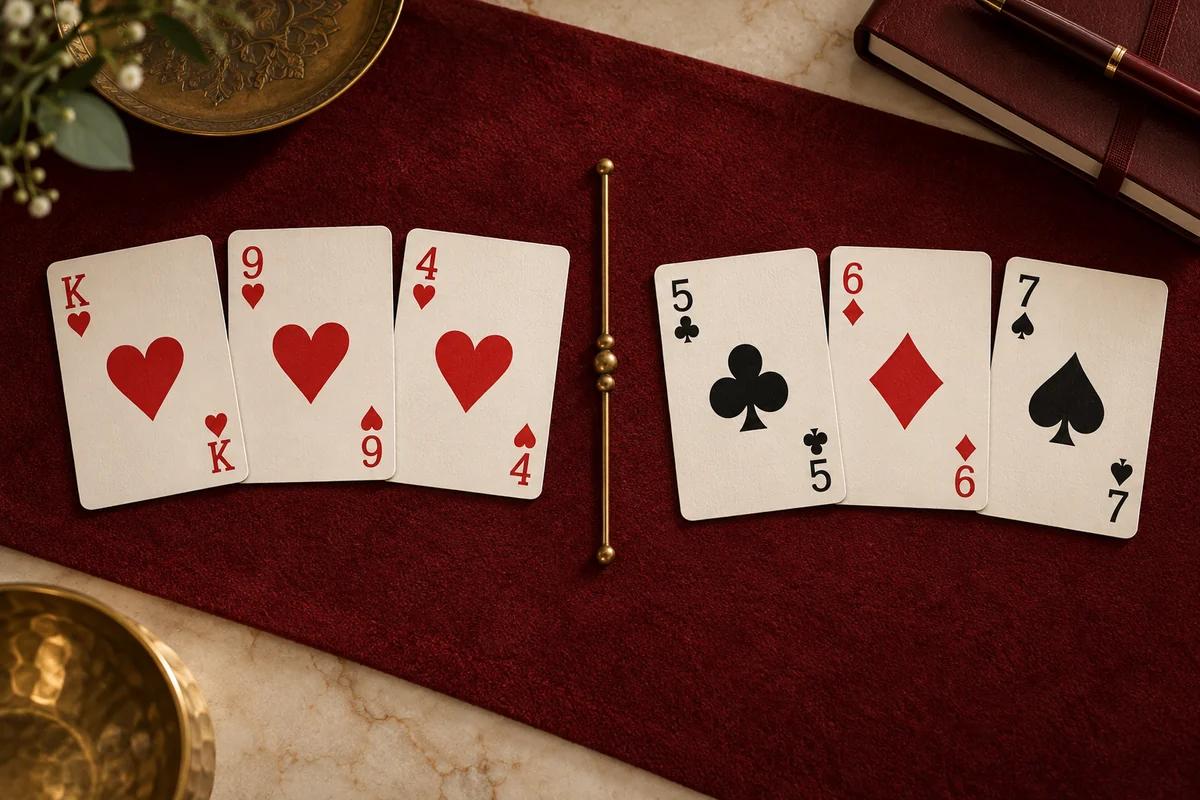
Illustration for this guide; not an app screenshot.
K♥–9♥–4♥ looks impressive beside 5♣–6♦–7♠: it has a king, and every card shares a suit. Yet the second hand wins under the ordinary high-hand Teen Patti order. It is a sequence, while the first is a colour. That comparison often goes wrong when players notice the biggest card before naming the hand. This guide uses small, reproducible examples to separate suit, rank and category. It describes ordinary three-card rules without jokers; a Muflis or other special table needs its own rule sheet.
Colour means one suit, not one ink colour
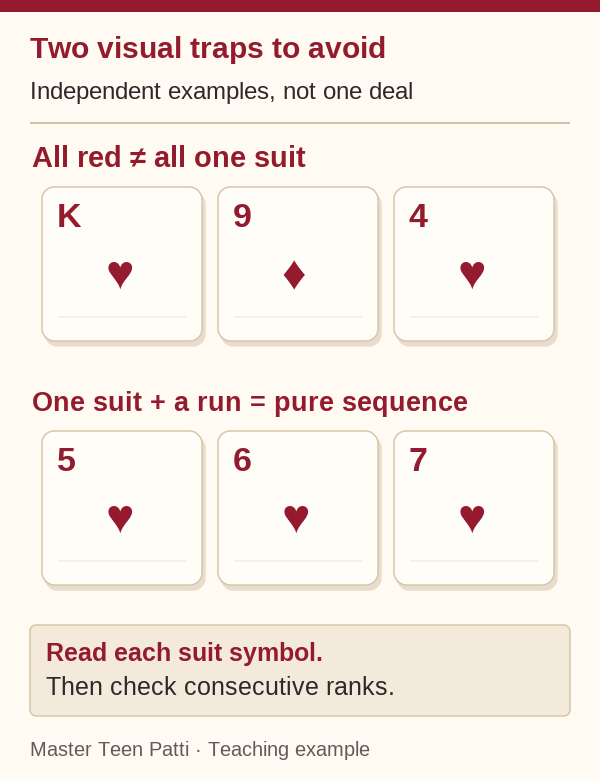
In this context, colour and flush describe the same category: three cards of one suit that do not form a sequence. Hearts and diamonds are both red, but they are different suits. K♥–9♦–4♥ therefore is not a colour. With no pair or accepted run, that particular hand belongs to high card. Three black cards can fail the same test when clubs and spades are mixed.
Start by saying the suit symbols aloud: heart, heart, heart is one suit; heart, diamond, heart is not. This is more reliable than describing a hand as “all red”. On a small phone screen, look at the symbol beside each rank rather than the background colour of the card. Keep that distinction when writing a comparison for another reader.
A sequence is a rank pattern
A sequence needs three consecutive ranks. The hand 5♣–6♦–7♠ qualifies because five, six and seven are consecutive, even though the suits differ. The hand 5♣–6♦–8♠ does not qualify: the seven is missing. A layout that puts cards close together on the screen cannot fill that gap.
Sorting helps, but it does not change the cards. If the display reads 7♠–5♣–6♦, rearrange the ranks mentally into five, six, seven and retain the original suits. Do not replace a card while sorting. For examples involving an ace, write down the table’s permitted runs and their order separately. You do not need an ace convention to settle the five-six-seven examples in this article.
Why the smaller-looking sequence wins
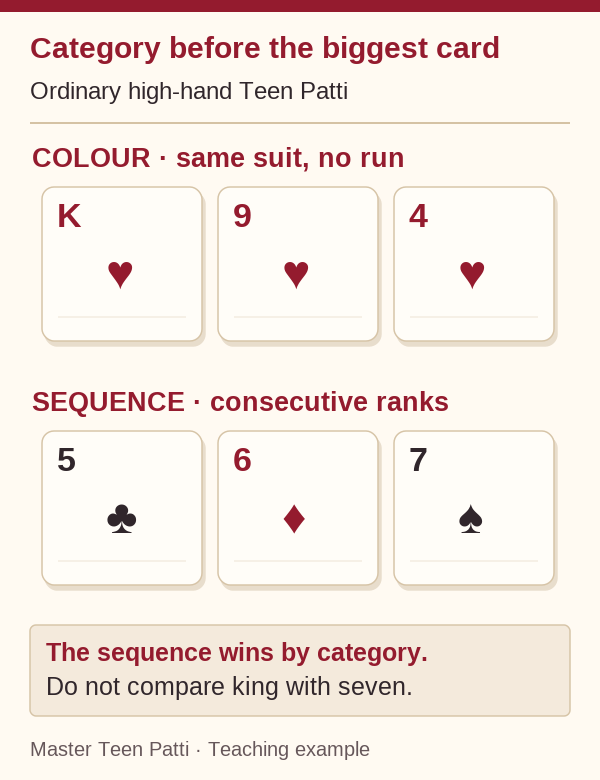
Return to K♥–9♥–4♥ against 5♣–6♦–7♠. Write two labels before comparing anything else: colour for the first hand, sequence for the second. In the ordinary category order, sequence is above colour. That settles this comparison. The king never gets compared directly with the seven, because individual ranks are not the first comparison across different categories.
A useful explanation is “sequence beats colour”, followed by the actual cards. “Seven beats king” gives the wrong lesson and will confuse the next hand. Likewise, the three values are not added into a score. This is a category comparison, not a contest between totals. Once you know why the lower-looking run wins, you can repeat the method with other ordinary ranks.
When one changed suit creates a pure sequence
Now use 5♥–6♥–7♥. It passes both tests: consecutive ranks and a single suit. Its most specific ordinary category is pure sequence. Although its cards share a suit, treating it merely as a colour would discard the stronger pattern. Classify the whole hand before assigning a label.
Compare three versions side by side: 5♥–6♥–9♥ is a colour; 5♥–6♣–7♥ is a mixed-suit sequence; 5♥–6♥–7♥ is a pure sequence. The difference is visible without any high cards or special ace rules. You can make a practice exercise by changing just one suit or rank, then asking which test changed. Keep the other two cards fixed so the reason remains easy to see.
Swipe across to see all columns.
| Hand | Category | Reason |
|---|---|---|
| K♥ 9♥ 4♥ | Colour | One suit; no run |
| 5♣ 6♦ 7♠ | Sequence | Consecutive; mixed suits |
| 5♥ 6♥ 7♥ | Pure sequence | Consecutive; one suit |
Two colours: compare the first rank that differs
When both hands are colours, category no longer decides the result. Sort each hand from highest rank to lowest, then compare corresponding positions. Consider A♥–J♥–6♥ against A♣–10♣–9♣. The aces match. The jack is higher than the ten, so the hearts hand wins; its six does not need to beat the nine.
For a third-card example, compare K♥–9♥–5♥ with K♣–9♣–3♣. King matches king, nine matches nine, and five beats three. Stop at the first difference rather than choosing whichever single comparison favours your hand. A worksheet with columns headed highest, middle and lowest makes this visible. Suit names identify the cards here; they are not an assumed extra ranking between otherwise equal colours.
Equal hands are a different question
A♥–J♥–6♥ and A♣–J♣–6♣ have matching ranked values in the ordinary comparison. Do not award the hand to hearts simply because you prefer the symbol. Once all ranked positions match, the remaining question is how that table resolves an equal comparison. A final show rule can also depend on who requested it.
Keep two conclusions separate in your note: “the hands have equal rank” and “the round is awarded according to this tie rule”. They are not interchangeable statements. If someone reports a different outcome, ask for the comparison context and the written rule before assuming the cards were misread. This distinction is especially useful when moving between a practice table, a house game and an unfamiliar app.
Check yourself with three short hands
Try these without reading the labels first. Hand A is Q♦–8♦–3♦. Hand B is 8♠–9♥–10♣. Hand C is 8♣–9♣–10♣. A has one suit but no consecutive ranks, B has a run with mixed suits, and C has both. Under ordinary high-hand rules the order is C, B, A.
For a second exercise, change A’s middle card from 8♦ to 8♥. It is now mixed-suit high card, not a weaker kind of colour. For a third, change B’s ten to a queen. That breaks the run; it does not make a sequence with a gap. Explaining the failed test is more useful than memorising the three answers. These examples are deliberately separate hands rather than a claim about one dealt round.
A compact method to keep beside the cards
Use the same reading order each time: write the three ranks and suits, decide whether the ranks form an accepted run, decide whether the suits match, and name the strongest qualifying category. Compare categories first. Compare individual ranks only if both hands belong to the same category. Then, if every comparison is equal, consult the table’s tie rule.
Does a colour beat a sequence? Not in the ordinary high-hand order used here. Are three red cards a colour? Only if they are also all hearts or all diamonds, without a stronger sequence pattern. Is every same-suit run merely a flush? No: classify it as pure sequence. These answers are about rules, not a prediction of the next deal or a guarantee about the linked Android app.
Sources & scope
Further reading checked on 26 October 2026.
Editorial topic

Aarav Sethi
Aarav explains Teen Patti hand rankings with clear card comparisons, showing which ranks matter and where a table-specific rule changes the answer.