

Illustration for this guide; not an app screenshot.
Two players remain, and someone asks for a show. That sounds simple until one player is blind, the other has seen their cards, or the hands turn out to be equal. A useful explanation needs more than a picture of two exposed hands. It needs the active-player count, whose turn it is, each player’s status and the applicable show rule. This guide separates those questions using paper examples. It is a guide to a published traditional ruleset, not a statement that a particular button or fee has been verified in Master Teen Patti.
Count active hands, not occupied seats
A person can still be sitting at the table after packing. Their seat remains occupied, but their hand is no longer part of the current comparison. Start with an active-player list. In the traditional rules described by Pagat, a final show belongs to the stage with two remaining players. If only one remains because everyone else packed, there is no opponent’s hand left to compare.
Imagine five labelled seats, P through T. Q, R and T have packed; P and S remain. The number that matters is two, not five. Now undo T’s pack in your example: there are three active hands, so the situation has changed even though no seat moved. This small bookkeeping step prevents a sideshow or a table animation from being mistaken for a final comparison.
Record blind or seen before the request
Blind and seen describe whether a player has looked at their own cards. They do not describe whether the other player can see those cards. A seen player can still have a private hand. Record the state before the show request, rather than trying to reconstruct it from the exposed cards afterwards.
In a paper example, give P a closed-card marker and S an opened-card marker. Those markers tell you that P is blind and S is seen; they say nothing about which hand will win. If P looks at the cards before requesting a comparison, update the marker at that point. Do not leave the old status in the record simply because P began the round blind. The order of events can change which rule you need.
Use one stated rule for eligibility and cost
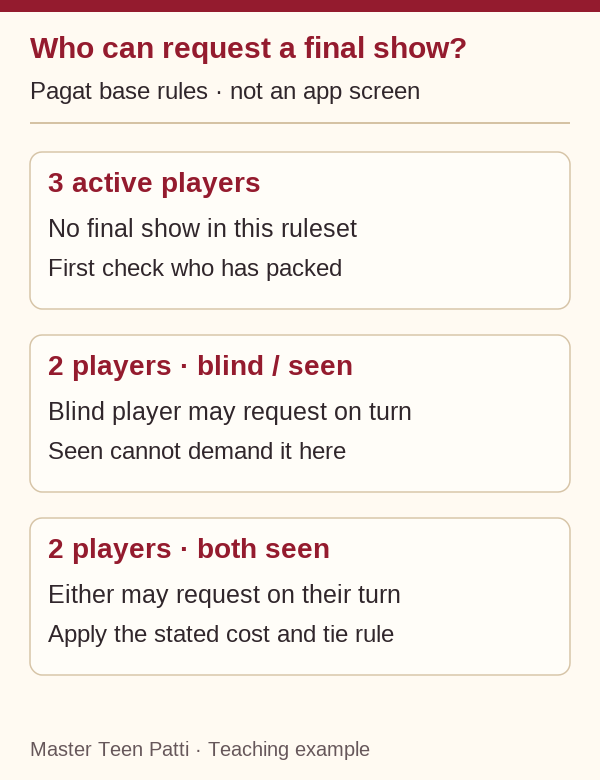
Under Pagat’s base description, the blind player may request a show on their turn at the current stake; a seen player cannot demand one against a blind opponent. With both players seen, the requesting player pays twice the current stake. The same source records different show-cost conventions, so those multipliers should not be treated as universal app settings.
For a teaching note, write the rule name and its unit before writing any number. A displayed pot total is not automatically the current stake, and a previous seen payment may not be the base unit either. If a table uses another convention, recalculate from that convention rather than quietly mixing two sources. You can understand eligibility without placing money or trying repeated requests in an app.
Swipe across to see all columns.
| Active hands | Status | Base-rule check |
|---|---|---|
| Three | Any | Not a final show |
| Two | Blind vs seen | Blind may request on turn |
| Two | Both seen | Either may request on turn |
Separate an unavailable action from a losing hand
Suppose S is seen, P is blind and S cannot request the final show under the chosen rule. That says nothing about S’s card strength. S might have the stronger hand; eligibility and ranking are different questions. Explaining the result as “my cards were too weak for Show” would confuse an action restriction with the later hand comparison.
Use a two-line record: first, whether this requester is eligible in the current state; second, how the hands would compare if a valid comparison occurred. Do not infer hidden cards from an unavailable control. An unfamiliar application may also have timers or other conditions, but without its own rules and a reliable observation, do not invent an explanation for its interface. Keep the paper rule and the product observation separate.
After a valid show, compare category first
For a fresh comparison example, P holds 7♠–7♥–Q♦ and S holds 6♣–8♣–J♣. P has a pair; S has a colour. In ordinary high-hand Teen Patti, S’s category outranks P’s. The queen does not rescue the pair, and the two sevens are not added together to beat the jack. Neither player’s earlier blind status changes this category order.
Now change the example to two pairs: P keeps the pair of sevens and S holds 9♣–9♦–2♥. Compare paired ranks first, so S’s nines beat P’s sevens. If the paired ranks were equal, the spare card would be the next comparison. Writing the category and deciding rank next to each revealed hand produces an explanation that somebody else can check.
Equal rank does not automatically mean a split
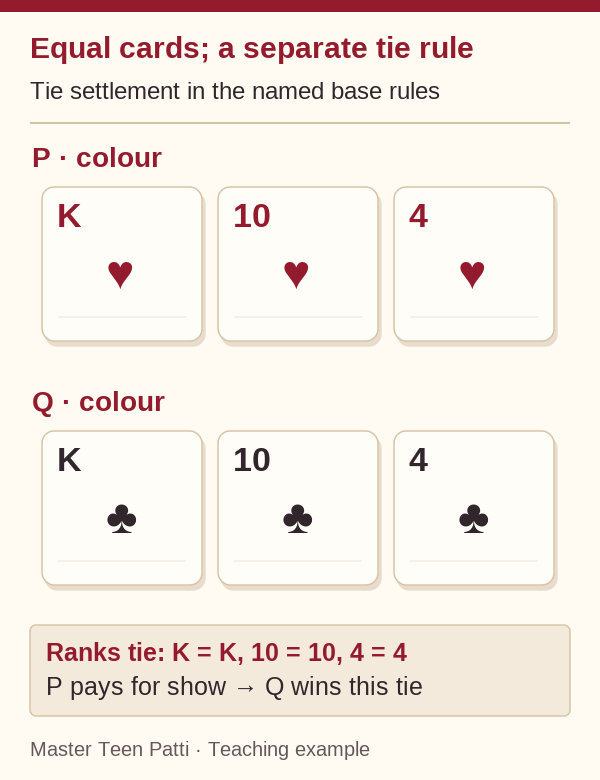
For the named base ruleset, equal hands at the final show are awarded to the player who did not pay for that show. That is a settlement rule, not an extra rank hidden in the cards. A different table must state its own treatment; do not import a split-pot assumption from another card game.
Use K♥–10♥–4♥ against K♣–10♣–4♣ as a paper tie. Both are colours, and every compared rank matches. Write “equal ranked hands” before applying the named tie rule. Then record who requested and paid for the show. If you swap that role while leaving both hands unchanged, this rule changes the recipient without changing the cards’ rank. Keeping those two stages separate is the easiest way to explain the outcome.
Do not use sideshow rules as a shortcut
A sideshow is a comparison within a continuing round; a final show settles the last two active hands under the rules used here. The names sound similar, but the state before and after the action is different. If three players remain after a comparison, describing it as the final show has lost an important part of the story.
Draw two timelines. In the first, four active hands become three after a permitted sideshow. In the second, two active hands reach a valid final comparison and the round is settled. Label the request, acceptance where applicable, comparison and result. This is a clearer learning tool than a screenshot of exposed cards without the preceding actions. The card picture alone cannot tell you which kind of comparison took place.
A five-field note resolves most explanation gaps
Before discussing a disputed show, collect five fields: active players, requester and turn, blind/seen status, the exact rule for eligibility and cost, and the revealed cards with the tie rule. A missing field is a reason to ask a narrower question, not to guess. Avoid posting account identifiers or private conversations when a simple card example will explain the issue.
Can a show happen with three active players? Not under the traditional final-show rule described here. Does being blind make the hand stronger? No; it changes the player’s information and available actions. Does this page confirm Master Teen Patti’s exact in-app show charge? No. Check the specific table’s written instructions. This guide helps you read those instructions and describe a comparison accurately, without promising a winning decision.
Sources & scope
Further reading checked on 26 October 2026.
Editorial topic

Diya Kapoor
Diya works on game terminology and English–Hindi explanations, connecting words such as boot, chaal and pack with the actions they describe.